This is one of my favourite spaces to share our new branding and website launches, along side some fantastic business information.
How to Reverse Engineer Your Competitor’s Keyword Strategy (Step-by-Step Guide)

If you’re struggling to rank higher on Google, your competitors might already have the answers you need. By analyzing their keyword strategy, you can uncover the exact search terms driving traffic to their site—and use that knowledge to boost your own rankings.
This guide will show you how to reverse engineer your competitor’s SEO strategy using SEMrush so you can target the right keywords, optimize your content, and stay ahead in search results.

Why Reverse Engineering Competitor Keywords Works
Instead of guessing which keywords to target, why not look at what’s already working? Your competitors have likely spent time (and money) optimizing their SEO. By analyzing their most valuable keywords, you can:
- Identify high-performing keywords with proven search volume.
- Discover content gaps where you can outperform them.
- Find low-competition opportunities they might be missing.
- Understand user intent and what kind of content ranks well.
The goal isn’t to copy their strategy, it’s to learn from their successes and apply those insights to your own site.
Step 1: Identify Your SEO Competitors
Before you can analyze a competitor’s keywords, you need to determine who your true SEO competitors are. These aren’t necessarily your direct business competitors, they’re the websites ranking for the keywords you want to target.
How to Find Your SEO Competitors Using Google
- Open an incognito browser window (to prevent personalized search results).
- Search for a high-priority keyword related to your niche.
- Look at the top organic results (skip ads and directories like Yelp).
- Identify websites that offer similar content or services to yours.
For example, if you run a wedding venue, searching for “best outdoor wedding venues” will reveal who ranks for that term.
How to Find Your SEO Competitors Using SEMrush
- Log into SEMRush and go to Domain Overview.
- Enter your website URL and hit “Search.”
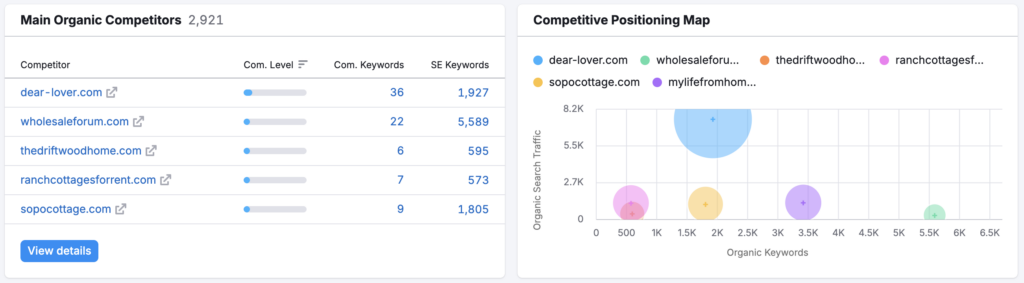
- Scroll down to “Main Organic Competitors.”
- You’ll see a list of sites competing for similar keywords.
Once you’ve identified 2-3 top competitors, you’re ready to analyze their keyword strategy.
Step 2: Analyze Your Competitor’s Keywords in SEMrush
Now it’s time to uncover which keywords are bringing your competitors the most traffic.
How to Find Competitor Keywords in SEMrush
- In SEMrush, go to Domain Overview and enter your competitor’s URL.
- Click on “Organic Research” in the left menu.
- Select your target country to filter the results.
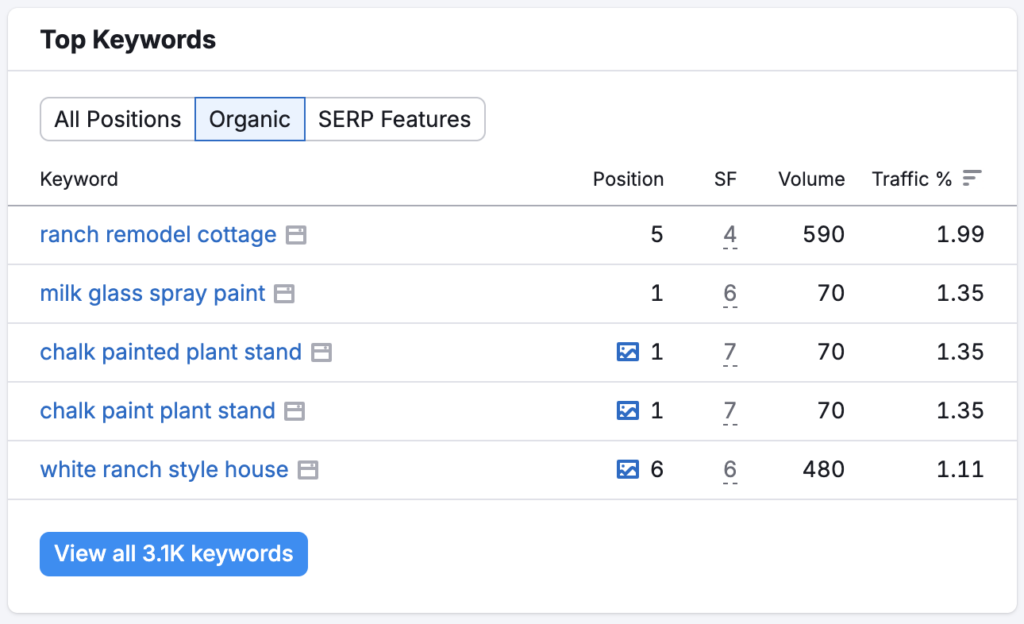
- Look at the Top Organic Keywords section.
This will show you:
- The keywords your competitor ranks for
- Their search volume (how many people search for them monthly)
- Their ranking position in Google
- The keyword difficulty (how hard it is to rank for)
To see only the best-performing keywords, filter by Top 10 Rankings.
Pro Tip: Export this list as a CSV file so you can organize it in Google Sheets.
Step 3: Find Their Best Pages and Keyword Buckets
Not all keywords are equally valuable. To get the best insights, look at which pages drive the most organic traffic to your competitor’s site.
How to Identify Top-Performing Pages in SEMrush
- In SEMrush, go to Organic Research > Pages
- You’ll see a list of their top-ranking pages, sorted by traffic.
- Click each URL to see the keywords it ranks for.
This helps you spot content topics that perform well in your niche. If one page is ranking for multiple high-traffic keywords, it’s a strong indicator that the topic is worth targeting.
Create Keyword Buckets
To stay organized, group keywords by topic (also called keyword buckets).
For example, if you run a travel blog and your competitor’s top-ranking page is about “Best Road Trips in the USA”, you might create a keyword bucket like:
- Best road trips in the USA
- Top scenic drives in America
- Road trip planning tips
This helps you structure your SEO and content strategy around what’s already working.
Step 4: Identify Easy Wins and Content Gaps
By now, you should have a list of keywords and content topics that are working well for your competitor. But how do you decide which ones to target?
Look for “Easy Win” Keywords
In SEMrush, filter keywords by:
✅ Position 11-20 – These are low-hanging fruit that almost rank on page one.
✅ Low Difficulty Scores – Easier keywords to rank for, even with a newer site.
✅ High Search Volume – Keywords that actually bring traffic.
These are the best keywords to target first because you have a higher chance of ranking quickly.
Find Content Gaps
Content gaps are topics your competitor ranks for—but you don’t.
In SEMrush:
- Go to Gap Analysis > Keyword Gap
- Enter your domain and your competitor’s domain
- Look at the “Missing” tab—these are keywords they rank for, but you don’t.
This is goldmine data for creating new content and improving existing pages.
Step 5: Apply Your Findings to Your Own SEO Strategy
Now that you have your competitor’s best keywords and content topics, here’s how to put that data to work:
1. Optimize Your Existing Pages
- Add new, high-ranking keywords to pages that are already performing well.
- Improve headings, meta descriptions, and internal links to boost rankings.
- Refresh old blog posts with updated content and keywords.
2. Create New Content Based on Content Gaps
- Write blog posts, guides, and landing pages targeting missing keywords.
- Use your keyword buckets to plan topic clusters.
- Create long-form content that beats competitors in depth and quality.
3. Monitor Your Progress
- Track rankings using SEMrush’s Position Tracking tool.
- Keep an eye on competitor updates every few months.
- Adjust your strategy based on what’s working.
Final Thoughts: Stay One Step Ahead of the Competition
SEO is all about learning from what’s already working and improving upon it. By reverse engineering your competitor’s keyword strategy, you can take the guesswork out of SEO and focus on what actually brings results.
Instead of spending hours trying to come up with the perfect keyword list, let your competitors do the work for you—then use their data to build an even better strategy.
Leave a Reply
Free, takes about half an hour, and you can leave the list whenever you like.
37 words and phrases that give AI copy away, plus the twenty minute fix for the most important line on your site.
PLEASE COMMENT BELOW